4JG2-T Turbo Problems

Before I introduce myself, I should warn you that I use a translator; English isn’t my native language. Therefore, if anything sounds odd in my speech, it’s due to the translator.

It’s unfortunate that I have to introduce myself using a post “asking for help” with a problem, but I must.

Let me introduce myself: My name is Sergio, “Lastra” is my alias on the forum, as that’s how I’m known in the off-road world. I’m from Asturias, in northern Spain, and I have a wonderful (or so I think) 1997 Opel Monterey, which is essentially a 1997 Isuzu Trooper 3.1TD disguised with Opel emblems. Mine, like all the others, was manufactured in Fujisawa, Japan, and imported to the Opel factory in Zaragoza, Spain, where they slapped on the emblems and sold them as Opels (due to the alliance with General Motors at the time).

Let me give you some background: I’ve always been a 4x4 enthusiast. In fact, the first car I ever drove was a Nissan Patrol K160 with an SD33 engine, and there were always off-road vehicles in my family. My father had an Opel Frontera (Isuzu Amigo) that was a terrible car with a 2.3 VM engine, and my uncle had a fabulous Isuzu Trooper 2.8TD with a 4JB1 intercooler engine, which he had to get rid of and couldn’t keep. As soon as I had the chance, I bought a Nissan Patrol, which I still own, and in 2023 I acquired this Opel Monterey with a 4JG2T engine, which has given me nothing but trouble since I got it.

I’ve already gone through four turbos with this one, and it keeps breaking down. I don’t know where the problem could be. I replaced the oil lines, cleaned the oil pan and oil pickup, and checked that the internal oil passages weren’t clogged (even the metal mesh inside the fitting that feeds both the turbo and the brake booster vacuum pump on the alternator). I also removed the oil filter housing and cleaned the two relief valves.

Currently, I’m using Motul 10W40 semi-synthetic oil, and the filter is the original Isuzu one for this engine. The oil pressure at idle when cold rises to approximately 4-5 bar, and when it warms up, it stabilizes around 2-3 bar. When hot, under acceleration, it slightly exceeds 3 bar.

I drove 3,000 km with the new turbo and I’m already having wear problems in the usual place: the turbo shaft bearing. Sometimes when accelerating, the compressor wheel makes a noise rubbing against the intake housing, and it briefly starts leaking oil.

I don’t know what to do anymore. According to a local turbo expert, the engine is carbonizing the oil and possibly has a clogged or even stuck piston ring oil seal.

Since I’m going to rebuild the engine, I’d like to get some information about a modification I’d like to make. I’ve read somewhere that a 4JG2 block can be fitted with the cylinder head, injection pump, injectors, and fuel lines from a 4JB1. Therefore, using pistons from a 4JG1-T or 4JH1, I could convert the 4JG2 into a direct injection engine. Since I’m already rebuilding the engine, this is an option I’m considering because I want to increase its power, as I’m going to install larger tires, and the 4JG2 cylinder head is sensitive due to the pre-chambers.

I look forward to hearing from someone who can help or guide me.

Thanks and greetings to all!

Welcome to the site, Sergio. I wish I could answer your questions. I’m a diesel driver, but I have no experience with the 4JG2-T or turbos in general.

But we do have some others with this engine. I believe @MudOilnGears my have expertise.

Thanks so much for your quick reply, Joe. We’ll wait to see what our colleague @MudOilnGears has to say.

Hi guys,

I snagged Sergio off of FB and sent him this way thinking that Mud might have some insight or input with all his various 4J shenanagins… also, if you havent already Sergio, check out https://4jperformanceparts.com/ out of Austaralia. Also https://dieselaustralia.com.au/product-category/miscellaneous/ these guys do larger injectors, and work on pumps… I know a lot of guys do crazy stuff with these motors downthere!!!

Good luck!

Welcome Mate
Can I ask what replacement Turbo’s you’ve used?
The cheap generic unbranded units don’t last very long.
An OEM remanufactured/Rebuilt Unit should last. But if you’ve purchased a couple from the same suplier, It could potentialy be a quality issue?
Have you confirmed the Oil Pressure at the supply line to the Turbo?
If your Oil is so “Abrasive” that its flogging out the Float Bearings in your Turbos.. I would imagine that it would be doing the same to the rest of your Engine Bearings?
Have you cut open your used Oil Filter to see if its got any “silver”?

It is extremely unlikely for the engine to be degrading the oil to a point that it would kill turbos. If that were the case, it would have wiped out the crank bearings by now.

3-4 thousand miles is very fast to damage a turbo. Are you sure the turbo feed line is unobstructed as is the drain line? Are the coolant lines clear of debris and circulating?

Also, if this is the only reason you are planning to rebuild the engine, don’t. Find a new mechanic first, as blown turbos is not a symptom of an engine that needs a rebuild.

First of all, thank you so much for replying, everyone.

I greatly appreciate the advice, but I need to emphasize a few things in order:

1st, the cooling system is perfectly clean. It’s true the engine used water instead of coolant, but it’s not clogged. It might be a little dirty, but the engine cools perfectly. It also has a new thermostat and a new, oversized aluminum radiator. I never overheated it.

2nd, I cleaned the oil system with a solvent-free flush additive, which guarantees that if any residue remains, it won’t damage the engine. To do this, I added new oil and a new filter, cleaned the system, drained it, and then added another filter and new oil.

  1. I removed the filter housing and, consequently, the heat exchanger on top. I opened the two spring-loaded valves: one a pressure regulator and the other a pressure relief valve, which bypasses the filter if it becomes clogged. It was clean, but I cleaned it again anyway.

  2. I removed the oil pickup tube and cleaned everything thoroughly, including the oil pan. I didn’t notice any unusual sludge or metal shavings.

  3. I had a new oil line installed and checked the return line to the oil pan. I also installed a pressure gauge in the middle of the line, and the oil pressures are correct. I have videos.

In conclusion, I believe the turbocharger has good lubrication, at least in the fuel line. However, I did notice that it seems to have too many gases in the crankcase. As a precaution, I also installed a new PCV valve. Even so, I see a significant amount of air escaping from inside the engine, even with the valve open. When I open the oil filler cap or dipstick with the engine running, it blows quite a bit—I think more than normal. Not enough to make the cap fly off, but I do notice that too much air is escaping, which leads me to believe the engine is definitely faulty, either with the piston rings or valve stem seals. Furthermore, the oil turns black quite quickly. I’m leaning more towards the piston rings, as in addition to some of the combustion pressure escaping to the lower part of the engine, they could also be contaminating the oil.

Temporary solution: I’m going to install another turbo cartridge, but to try and extend the life of this one, I’m going to run a direct line to the air or a separator (from the oil dip tube that connects to the PCV valve) and block off the line that goes from the PCV valve to the intake, leaving that one open to the air. This will also prevent oil from getting into the intercooler.

I hope this turbo lasts me more than 3,000 km, at least until the end of the year, and then later I’ll start rebuilding the engine. I also want more time to research how to convert the engine to direct injection using the 4JB1 cylinder head and the 4JG1T pistons.

how much are you boosting? pushing a turbo too far beyond its efficiency island will cause it to shred itself pretty quickly

Stock, all stock, injection pump, turbo boost, and I never drive over 100km/h.

im not familiar with diesels and how they manage boost, but could somthing like a wastegate be stuck shut causing overboost? do you have a boost gauge to measure manifold pressure to check up on it?

just some ideas

Just to make sure, these don’t have the Delphi ECUs right?

It’s been a really long time since I was knowledgeable about turbo set-ups, but aren’t diesels different because they don’t have a throttle body? I thought diesels didn’t utilize a blow-off valve. Am I remembering incorrectly?

No BOV, just a wastegate and and overboost protection valve. But it would have to be really severely overboosting to damage a turbo. These turbos are capable of a long life at much higher boost levels than stock.

100%..

@Lastra
Definitely run a catch can on the PCV.
But maybe use the exhaust as a Vacuum source? Like they do on Track cars.

Definitely sounds like Rings to me, causing Blow by.
This would also be causing Wash Down of your engine oil,
Making the Oil shear under load sooner and less lubricating.

And

Likely to be the reason for chewing out the Turbo Bearings..
While your engine bearings would also be getting flogged.
They won’t be as quick to fail.

Because

The Turbo Float bearings being:

  1. a softer material
  2. smaller diameter- thus less surface area
    3)dealing with much higher surface speeds
    4)in a much harsher, hotter environment than the engine bearings.

If the oil contains a high percentage of diesel..
It’s also probably vaporising the moment it hits the Turbo CHRA.
Even in water cooled units, the rear Bearing is still receiving a vast majority of all that exhaust temperature.

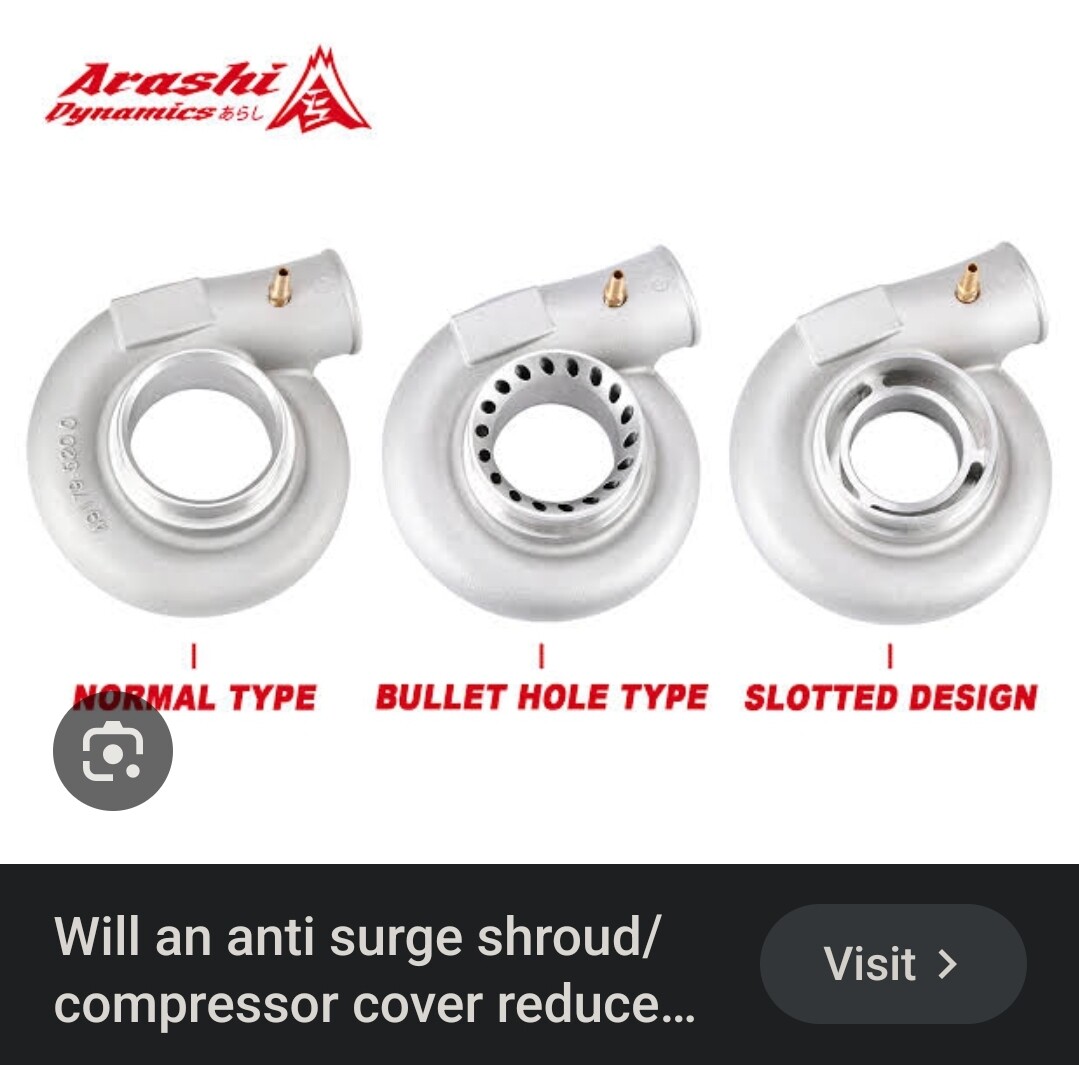
Turbos on Diesel engines cop a fair share of Compressor Surge/Stall compared to Petrol engines as well..
because they don’t run a BOV..
Compressor Surge can be pretty hard on the Turbo Bearings…
The Thrust bearing gets hammered..

Turbos that aren’t adequately lubricated, Don’t last very long at all.
A ceramic ball bearing model will out last a Float Bearing unit in this situation.

heavy blow by quickly diluting the oil makes a lot of sense, lastra even mentioned potential ring failure and crankcase pressure venting when opening the oil cap or dip stick. i dont know why i didnt connect the two like that. good thinking!

For this to happen, the oil level would have to rise considerably.

I’ve run a boost gauge extensively, never seen this.

Thats because its air..:face_savoring_food:

But you can hear it on big Trucks when they back off the throttler.
And Toyota Hilux’s when they put a pod filter on them..
And back off the throttler..

1 Like